

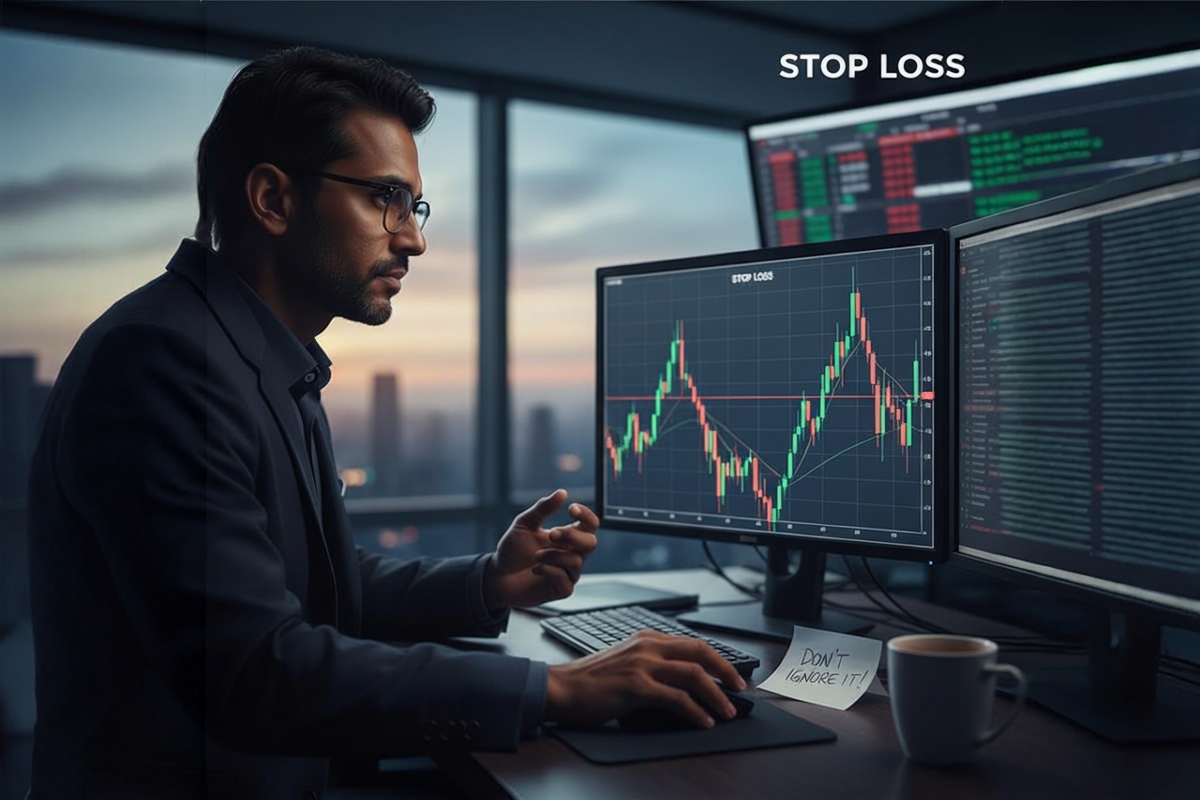
In the world of stock market trading, one rule separates professionals from beginners risk
management. And the most basic tool of risk management? Stop Loss.
Yet, most retail traders ignore it.
In fact, one of the biggest reasons traders lose money in Futures & Options trading is because
they don’t use proper stop loss discipline, especially in highly volatile markets like the National
Stock Exchange.
Let’s understand why stop loss is so important and why traders avoid it.
What is Stop Loss in Trading?
A stop loss is a predefined price level where your trade automatically exits if the market moves
against you.
Simple meaning:
It limits your loss before it becomes dangerous.
Example:
You buy an option at ₹200 and set a stop loss at ₹170.
If price falls to ₹170, the trade closes automatically.
Your loss is controlled.
Without stop loss?
The same trade could fall to ₹120… ₹80… even zero.
Why Is Stop Loss Important in F&O Trading?
Futures & Options (F&O) trading is highly volatile. Prices move fast, especially in instruments
like Nifty and Bank Nifty.
Without stop loss:
- Losses grow quickly
- Emotions take over
- Capital gets wiped out
- One bad trade can damage the account
Stop loss helps in:
- Protecting trading capital
- Maintaining risk-reward ratio
- Reducing emotional stress
- Ensuring long-term survival
Remember:
In trading, survival comes before profit.
Why Do Most Traders Ignore Stop Loss?
Despite knowing its importance, many traders still avoid using stop loss. Here’s why:
1. Hope & Emotional Bias
Traders think, “Market wapas aa jayega.”
But hope is not a strategy.
2. Fear of Getting Hit
Some traders avoid stop losses because they don’t want to accept a small loss.
Ironically, avoiding small losses leads to bigger losses.
3. Overconfidence
“I know market reverse karega.”
The market doesn’t move based on confidence.
4. Lack of Risk Management Knowledge
Many beginners focus only on entry strategies — indicators, breakouts, signals — but ignore
exit planning.
Professional traders focus more on exit than entry.
Stop Loss Is Not About Losing, It’s About Protection
There is a common misunderstanding:
“Stop loss means accepting defeat.”
Wrong.
Stop loss means protecting your capital.
A professional trader thinks in probabilities.
Not every trade will win.
But if losses are controlled and profits are allowed to run, long-term consistency becomes
possible.
The Golden Rule of Trading
Before entering any trade, ask:
- How much am I willing to risk?
- Where is my stop loss?
- Is the risk-reward ratio favorable?
If you don’t know your stop loss, you are not trading — you are gambling.
Final Thoughts
In volatile markets, discipline matters more than prediction. Stop loss is not optional.
It is compulsory for serious traders. If your goal is long-term growth in F&O trading, start focusing on risk management instead of only profit targets.
Because in trading:
First, protect capital.
Then, grow capital.